


The nation’s first university-led space electronics testing facility
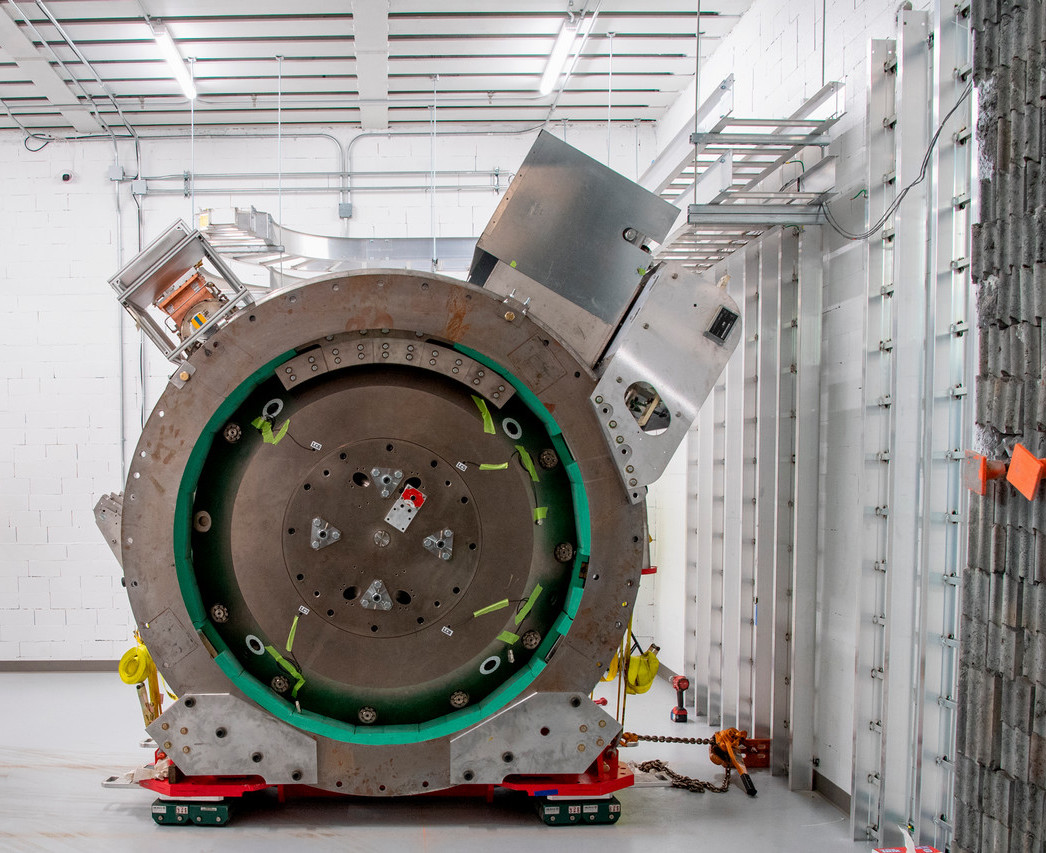
AUARI's 50,000-square-foot Radiation Hardening Facility is helping address one of the nation's most critical testing shortages. Home to the nation's first university-led proton testing center dedicated to qualifying space electronics, the facility features a superconducting 200 MeV cyclotron that enables government and industry partners to evaluate whether advanced microelectronics can withstand the harsh radiation environment of space before deployment on mission-critical systems. The facility's primary mission is to support the Missile Defense Agency, with additional availability for other U.S. government and commercial partners.
Testing for Mission Success
Satellites, missile defense interceptors, spacecraft and launch vehicles all rely on electronics that must continue operating despite constant radiation exposure. A single radiation-induced fault can compromise an entire mission, making rigorous testing essential before deployment.
The Mevion RAD-FX-200 accelerates protons to 200 MeV, accurately simulating the radiation environment encountered in near-Earth orbit and during solar particle events. Engineers can evaluate how microelectronics respond under these conditions, reducing risk before systems reach the field.
Meeting a National Need
Federal reports have identified a significant shortage of radiation effects testing capacity in the United States, with demand exceeding available testing time by an estimated 3,000 hours annually. At full capacity, AUARI's facility will provide up to 2,000 hours of proton testing each year, helping close nearly two-thirds of that gap.
The facility's primary mission is to support the Missile Defense Agency, while also serving other U.S. government agencies and commercial partners developing next-generation space and defense technologies.
Testing operations are scheduled to begin in January 2027, with full operating capacity expected in 2029.
- Proton Testing: High-energy Single Event Effects (SEE) testing.
- Laser SEE Testing: Includes laser single event effects capabilities and characterization services.
- Total Ionizing Dose (TID): Utilizing Cobalt-60 (Co60) sources in both Huntsville and on the main Auburn campus.
- CubeSat Validation: Uses CubeSat-class testbeds for rapid on-orbit validation of disruptive technologies.
- Advanced packaging/reliability

