


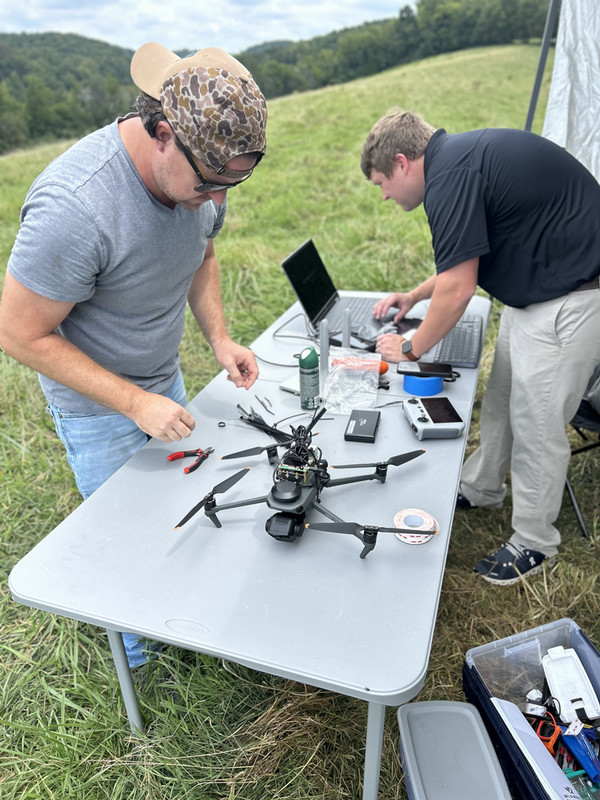
Accelerating Operational Autonomy from Mission Need to Fielded Capability
The Robotics for Operational Autonomy Research (ROAR) Lab at Auburn University Applied Research Institute bridges the gap between emerging autonomy research and deployable capability. ROAR rapidly designs, builds, integrates, tests, and transitions robotic systems through mission-focused engineering, advanced manufacturing, and experimentation in operationally relevant environments.
Why ROAR?
- Enables Industry & Government – Auburn University does not compete with industry; ROAR exists to help industry and government solve their most difficult autonomy challenges.
- Solves Hard Problems – Multidisciplinary engineering teams rapidly design, prototype, integrate, and test solutions to accelerate technology transition.
- Access to World-Class Expertise – Connect with experienced subject matter experts across autonomy, robotics, aerospace, RF systems, computer vision, navigation, and advanced manufacturing.
- Advanced Facilities & Equipment – Leverage specialized laboratories, cutting-edge engineering tools, advanced manufacturing equipment, and integrated test capabilities that are often inaccessible to individual organizations.
- Accelerates Innovation – Reduce technical risk and shorten development timelines through rapid engineering, prototyping, experimentation, and operational testing.
- Develops Tomorrow's Workforce – Train the next generation of robotics and autonomy engineers through hands-on development of real-world defense and commercial systems.
- Supports National Security – Advance operationally relevant autonomous capabilities that strengthen America's technological advantage—from strategic missions to the individual warfighter at the tactical edge.
Core Technical Capabilities
- Ground and aerial uncrewed systems, sUAS payload integration, custom flight controllers
- Computer vision, autonomy algorithms, machine learning, sensor fusion, Kalman filtering
- GPS-denied navigation, APNT solutions, vision/RF-assisted localization
- RF telemetry, resilient data links, mesh networking, distributed robotic communications
- Aircraft conceptual design, sizing, aerodynamics, propulsion, structures, and analysis
- Additive manufacturing, composites, metal AM, topology optimization, rapid fabrication

